24 March 2016

SHOWDOWN: The Damsel in Distress versus The Distressed Damsel

FIRST, SOME BACKGROUND:

I was struck by an Instagram post the other day, in which the poster was defending her love of Twilight and Bella in particular: "Personally, I love Bella & the fact that her character was sometimes weak & awkward, like myself, but strong when she needed to be, making her more relatable. She's sometimes called 'the girl who did nothing', and that's okay, too! Not every female character should have to save the world to be accepted & liked."

If you've been my friend in real life for any amount of time, you know how I feel about Bella (here's an academic paper I wrote on her, just to make it official). Her transformational journey is EPIC in my eyes, especially as it is motivated by love and her entrance into motherhood. I never saw her as a damsel in distress, but more as a distressed damsel, one who is overwhelmed by circumstances that were out of her control. (More on that later.) Then, the other night, I was watching Jupiter Ascending and during a slow part (good movie that needed work--it happens), I read a comment on a review of the movie that Jupiter was a typical damsel in distress. That made me mad. Jupiter was in a UNIVERSE where she had little to no power and no knowledge to draw on. Yeah, she was in distress! But that didn't mean she was making stupid decisions--she was doing the best she could with what she had. 


So, combine that mental snit with the very entertaining-yet-informative blog post that I read earlier this week from Ilona Andrews--Brief Analysis of Alphahole in Romantic Fiction--and suddenly this blog post began to roll around in my head. I'll also be referring to Heather Farrell's great post The Reason You Love Jane Austen and I Bet You Didn't Even Know It, which clarifies what a maternal feminist is, among other things. Trust me, it's important. 


There. Necessary contextual clarifications are now out of the way. 


THE MAIN POINT: 

In media, there are several kinds of female characters--take charge women who can save themselves, damsels in distress, distressed damsels, solely-the-love-interest heroines, the funny fat friend who provides the important information at just the right time, the missing mother, and so on. There will be shades of both, because there is very little in this life that is completely black and white, and there will be variations of them all that will amuse us, but I think that a distinction needs to be made between the two damsels.


To me, a damsel in distress is a main character who is confronted by a conflict that they *could* take on but that they choose not to handle, instead waiting for a stronger, more knowledgeable character to swoop in and save them. On the other hand, a distressed damsel is a main character who is confronted by a conflict that is *out* of their control, does their best with the power, knowledge, and resources available to them, often to the point of self-sacrifice, and are saved by a stronger, more knowledgeable character (often an alphahole who has been put in touch with their humanity--thank you, Ilona Andrews, for giving that character definition).


Examples of a damsel in distress, according to the above definition, are therefore limited to two characters that I can think of: Disney's Snow White and Princess Buttercup. 

DAMSELS IN DISTRESS


Snow White is an absolute IDIOT who *will not* listen to the advice of the more experienced people around her and gets into trouble because of it. (Maybe she's a dwarfist. Anyway.) She proceeds to fall into the arms of the stranger who rescued her and agrees to let him take her away. No character growth there. She doesn't take steps to defeat the villain or learn to look outside herself or improve herself in any way.


Princess Buttercup is pretty much the same way. I have always questioned what Westley found in her to love, since she is an absolute LUMP. She allows herself to be moved from position to position, like a pawn on a chessboard. Her only redeeming action is when she jumps ship to swim away from Vizzini and crew. Even then, she doesn't evaluate her surroundings--she is merely looking to get away. Same with her suicide attempt after her marriage to Humperdinck--her attempt to end her life wasn't to achieve some greater purpose, but to remove herself from the situation, even after she had reassured Humperdinck that "...my Westley will save me." She does nothing to slow events down or make it easier for Westley. She has completely ceded control of her life to the men around her. (I must say, I do love the movie. But it's not because of her!)


STRONG, CAPABLE WOMAN WHO HAS POWER, KNOWLEDGE, AND RESOURCES AND THEREFORE IS *NOT* PART OF THIS DISCUSSION


On the other end of the heroine spectrum are characters like Rey from The Force Awakens. They have the power, knowledge, and resources to save themselves--and they DO. I like them. But I'm not talking about them.


DISTRESSED DAMSELS


Then there is the distressed damsel. A lot of so-called "damsels in distress" actually fall into this category. They are characters who are thrown into situations where they lack one or more key things: knowledge, power, or resources. However, when faced with the inevitable terrible choices forced on them by the antagonists, they do the best they can, even if it means a sacrifice of self or of something they love. They are often saved by a protector, often an alphahole who has found a new side to himself after encountering the distressed damsel and seeing the world and his situation through new eyes. It's important to note that the alphahole/protector chooses to protect the distressed damsel because they have the potential for an ideal relationship, as demonstrated in Jane Austen's novels over and over again, "...a relationship where both the man and the woman were intellectual and moral equals and treated each other with mutual respect and equality," (Farrell, The Reason You Love Jane Austen...). This ideal relationship will often cross a kind of boundary that would normally be an impediment to the relationship, but the distressed damsel and the alphahole will set aside their prejudices to make this match of equals work. 

 For this post's sake, I'm going to just use three characters--Sleeping Beauty, Bella Swan, and Jupiter Jones--to demonstrate the classic distressed damsel.


Sleeping Beauty (Disney version)--OK, first of all, fairy godmothers are the *worst* pick for guardians/protectors EVER. When it comes to knowledge, power, and resources, they could have armed Aurora with a complete understanding of the curse on her and made her aware of the consequences. Instead, they tell her not to talk to strangers. NOT HELPFUL, LADIES. Then they suddenly inform her that she's a princess and now she needs to leave the only life she's known--as a peasant!--to take up her new role. Because that's something you can just step into! So, Aurora has no knowledge. She has no power, because she doesn't have the magic to counter or avoid the curse. And she has no resources because she was a princess for AN HOUR before everything went to pieces. Therefore, she is a distressed damsel. To his credit, Prince Phillip met her before everything went nutso, so for him to protect and defend her makes sense--she didn't end up just falling into the arms of a stranger, a la Snow White.


(Image from fanpop.com)

Bella Swan--First, we have to identify the antagonist here. It's Victoria and the Volturi--they're the ones who seek to destroy Bella's way of life, who have the power and the resources and the knowledge to do so. Some would say that Edward is abusive because he's controlling, but as Ilona Andrews puts it in her Alphahole post, he's a caretaker with alphahole tendencies:

 "...note that caretaker hero type falls closer to alphahole on the a-hole spectrum than to beta male. Caretaker hero is driven by an overwhelming urge to protect and take care of the heroine
 and in the name of keeping her safe, he might exhibit serious alphahole tendencies, 
as demonstrated by Edward in Twilight series." 

Edward is using the knowledge and strength and resources he possesses to protect his true love, Bella. He isn't seeking to dominate her, but to keep her safe when she cannot, because the enemies they face are SO powerful. When Bella becomes a vampire, she comes into the knowledge, power, and strength she needs to take care of herself--and she does so. She not only protects herself, but her family and everyone she loves. The distressed damsel, when she had the power and knowledge and resources, handled it.


Jupiter Jones--same story, different universe. Jupiter has no idea she's the exact genetic match of semi-alien royalty, she doesn't know that she has inherited a vast amount of property, she is schemed against by the very people (her genetic predecessor's children) who should be imparting knowledge so that she can properly use her resources and the power they bring. She doesn't receive any more powers, but at the end of the movie, her protector, Caine, shared the tech that he could with her and the viewer sees that she's learning to use the resources of the new world she is now aware of. Caine may have saved her from various dangerous situations, but every time he was aided by the fact that she was doing the best she could with the knowledge she had--even to the point [SPOILER ALERT] of willingly sacrificing her family and herself to save the Earth [END SPOILER]. Jupiter was a distressed damsel, but she was handling it.

CONCLUSION:

The difference between the damsel in distress and the distressed damsel is important. It can affect worldviews and the values we hand down to our children. As a maternal feminist, I see the value in stories that show men and women working together to solve problems, as well as stories where the woman saves herself. They both have value and resonance, and stories of the distressed damsel show that it's okay to ask for and to accept help. Asking for help or allowing someone to help her does not devalue her contribution--it means that she had the humility and the self-awareness to know that the situation had gotten beyond her. 

So, the moral of the story? (TL;DR!) 

It is perfectly acceptable to allow other people to help! It does not decrease your value, your worth, or your contributions. And it certainly isn't anti-feminist.

THE END


23 March 2016

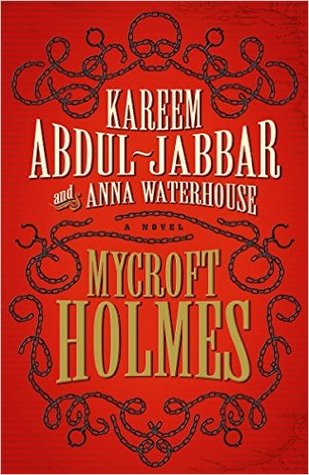
Mycroft Holmes

My eye is almost always caught by interesting dichotomies. For instance, seeing this cover prominently displayed on the New Book shelf in my library:


Unexpected, no? I grew up hearing Kareem Abdul-Jabbar's name announced over the background of athletic shoes squeaking across hardwood floors and the shrill of referee whistles. But here he is on the cover of a book about Sherlock's brother? This I must see.

From Goodreads:
"Fresh out of Cambridge University, the young Mycroft Holmes is already making a name​ ​for himself in government, working for the Secretary of State for War. Yet this most British of civil servants has strong ties to the faraway island of Trinidad, the birthplace of his best friend, Cyrus Douglas, a man of African descent, and where his fiancĂ©e Georgiana Sutton was raised.

Mycroft’s comfortable existence is overturned when Douglas receives troubling reports​ from home. There are rumors of mysterious disappearances, strange footprints in the sand, and spirits enticing children to their deaths, their bodies found drained of blood. Upon hearing the news, Georgiana abruptly departs for Trinidad. Near panic, Mycroft convinces Douglas that they should follow her, drawing the two men into a web of dark secrets that grows more treacherous with each step they take...

Written by NBA superstar Kareem Abdul-Jabbar and screenwriter Anna Waterhouse, Mycroft Holmes reveals the untold story of Sherlock’s older brother. This harrowing adventure changed his life, and set the​ stage for the man Mycroft would become: founder of the famous Diogenes Club and the hidden power behind the British government."


I love Sherlock Holmes. The Hound of the Baskervilles gave me nightmares when I was 11, but no other detective could compare to Sherlock's observational skills and quick mind, not even Encyclopedia Brown (though good ol' Encyclopedia Brown did NOT disturb my slumbers with red-eyed slavering dogs chasing after me). I've read the majority of Conan Doyle's Sherlock canon, Laurie R. King's continuation of the Sherlock lore, and watched avidly as both Robert Downey Junior and Benedict Cumberbatch portrayed the fierce, unemotional detective on the screen. I wondered if Mr. Abdul-Jabbar could do his brother justice?

In a word, yes.

My husband tells me that Mr. Abdul-Jabbar is a well-known Sherlockian fan, so the novel is not that great of a leap. And it shows in the storytelling--the plot is tight, with echoes of Conan Doyle's ever present theme of the past catching up with the miscreants of now driving the story. The characters are well-drawn, and I'm curious to see more of the Holmes' dear mother, who is portrayed as the perpetrator of their difficult personalities. The new characters of Georgiana and Douglas fit well into the milieu and lend spice to what could have been a very bland narrative. This was a truly enjoyable read, gripping, with remarkable attention to character detail and some very cleverly disguised info-dumping. Well done.

Gentle Reader Alert: Mycroft has to deal with some harrowing situations (see the dead children referenced in the plot synopsis) and there is some period swearing, but it was not overt or offensive to me.

22 March 2016

Vivian Van Velde

There should be a saying in the book world, something equivalent to "Better late to the party than never to have attended." I've seen Vivian Van Velde's name slung around in different places, but hadn't really paid attention, often because when it comes to book recommendations, I have the attention span of a gnat.

Thankfully, her name stood out to me again when I was perusing my little library's bookshelves, desperately trying to scratch the current literary itch (still urban fantasy, thanks).

My wandering hands jumped to this book, Heir Apparent, and the description seemed like it fit my needs, so I gave it a shot.

From Goodreads: "In the virtual reality game Heir Apparent, there are way too many ways to get killed--and Giannine seems to be finding them all. Which is a darn shame, because unless she can get the magic ring, locate the stolen treasure, answer the dwarf's dumb riddles, impress the head-chopping statue, charm the army of ghosts, fend off the barbarians, and defeat the man-eating dragon, she'll never win.

 And she has to, because losing means she'll die--for real this time."

First of all, I love playing point and tap games on my tablet. I'm in the middle of Steve Jackson's Sorcery! and loving it--and reading this book was a lot like watching someone else play the adventure for me. BUT BETTER. Why? Because I loved Giannine's voice. She was level-headed and stubborn but willing to learn and NOT an inexplicable genius at this one thing (bonus points!). The game itself was intriguing and compelling. The story was adorable and superior--the intertwining of the virtual world and the real world was well-played. I was rooting so hard for that girl to make it through! All in all, I found Heir Apparent to be a very satisfying read--as have both my daughters, who are 10 and 12. (Gentle Reader Alert: I found nothing of concern.)

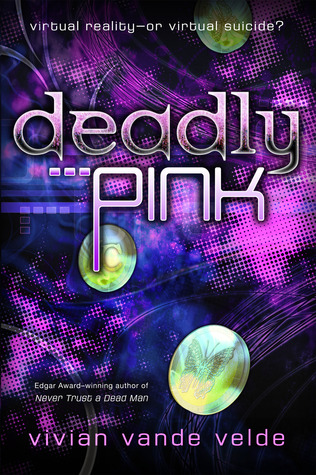
Since it was such a favorable experience, I picked up Deadly Pink the very next week.
Same world as Heir Apparent, but the players are much different, and the tone is a bit heavier. Not darker, necessarily, but heavier.

From Goodreads: "Grace Pizzelli is the average one, nothing like her brilliant older sister, Emily, who works for Rasmussem, creators of the world’s best virtual reality games. The games aren’t real, though—or at least they weren’t. Now Emily has hidden herself inside a pink and sparkly game meant for little girls. No one knows why, or how to convince her to come back out, and the technology can’t keep her safe for much longer. Grace may consider herself average, but she’s the only one who can save Emily. So Grace enters the game, hoping to talk her sister out of virtual suicide before time runs out. Otherwise Emily will die—for real."

Yep, suicide. However, I found this to be a great springboard book--the threat of suicide isn't violent or imminent, and it will give me a chance to talk to my daughter about why people sometimes think ending their lives is the right choice, and what we can do about it. My 12-year-old has eaten this up, partly due to the video game world that the Pizzelli sisters have to conquer (I love the bits with the angry pixies--they made me laugh), but partly because as she gets older, she's beginning to understand that people are complex and make decisions for many reasons, not just one. Ms. Van Velde handles the situation with dexterity and grace and compassion, much as Grace herself does. (Gentle Reader Alert: There's no swearing or sex, but one of the main characters is trying to commit suicide by video game--a pink and purple video game filled with fantasy characters....)


And since I was having such a good time with Van Velde's stories, I picked up Stolen too, despite the horror-centric cover. The 10-year-old is into mild horror, so I thought I'd preview this one for her. I didn't expect to LOVE it.

From Goodreads: "The same day that the villagers of Thornstowe finally hunt down a witch with a reputation for stealing children, a 12-year-old appears in the woods with no memory of her past. Is there a connection between Isabelle, the girl who doesn't know who she is, and the girl the witch stole six years earlier?

One of the few things Isabelle remembers is a chant that keeps running through her head: Old as dirt, dirty as dirt. Ugly as sin, mean as sin. Don't let the old witch catch you!

 Could Isabelle have been stolen by the old witch of the woods, or has she lost her memory as the result of an accident? And what about the baby the witch stole right before the villagers attacked? Did either the witch or the baby survive the fire the villagers set?"

There is so much twistiness to the plot of this story--I did NOT see the end coming--and the characterization is spot-on. Absolutely adored it and have NO qualms about handing it off to the 10-year-old. I think she'll really enjoy it too. (Gentle Reader Alert: I found nothing of concern, but I would definitely keep it for more mature middle-grade readers. Trust me.)

Do yourself a favor. Pick up a story by Vivian Van Velde sometime soon and get lost in it. You'll enjoy the adventure.

29 February 2016

Magisterium Series

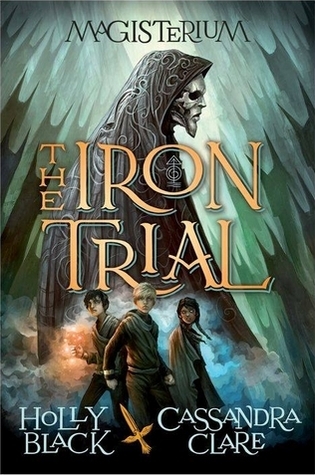
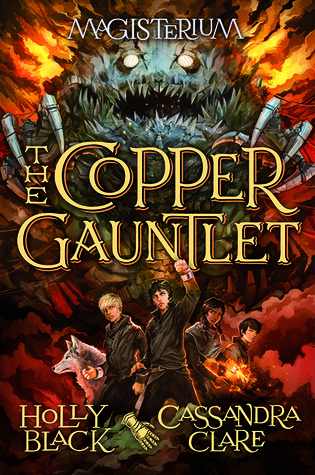
I really should give a shout-out to the youth services librarian at my local branch--I told her of my literary itch (as referenced in the last post) and she recommended the above books: The Iron Trial and The Copper Gauntlet by Black & Clare.

I adored The Mortal Instruments when they first came out--the world-building and plot were divine, the characters intense. The only thing that lost me was the tangled romantic situation around Jace and Clary. Then Clare inexplicably chose to continue the series. I tried City of Fallen Angels and hated it. As for Holly Black, I tried The Spiderwick Chronicles, but they were too dark for me. (I won't read Lemony Snicket either and  YOU CAN'T MAKE ME. Nyah nyah. So sue me, but I like a good HEA. Or at least a smidgen of hope and uplift in a book. ANYWAY.) I did like Geektastic, so there's that.

I'M GETTING TO MY POINT.

I knew that Black & Clare were queens of urban fantasy, which is what I wanted, but I didn't want dark and hopeless. (See ever-so-mature parenthetical rant above.) So, on the librarian's advice, I gave the Magisterium series a shot.

The Iron Trial was hard for me. It's a good read--compelling and interesting--but it hits every. single. beat. that makes Harry Potter the character he is. I would be specific about these points, but I don't want to spoil the story. In the notes I made after reading the book, I have: "ALL PLOT POINTS BELONG TO HP. ALL." Done well, no harm, no foul. But this was so BLATANT.

HOWEVER. (There is an excess of all caps in this review. Forgive me, but they are necessary to convey ALL THE EMOTIONS.) There is *just* enough different about Callum and the magical world he inhabits that I had high hopes for The Copper Gauntlet...and I was right. THANK GOODNESS. The plot takes a left-hand turn that I didn't see coming right at the beginning of Copper Gauntlet that made all my frustration with The Iron Trial worthwhile. Copper Gauntlet left all vestiges of Harry Potter behind and forged its own path, asking questions about how far to trust authority and other people's assertions and all that you think you know about yourself--ripe questions that all adolescents really want to know the answers to as they start to form their own independent worldviews.

Overall, I think that this will be a journey worth taking. Rough start (for me, anyway), but worthwhile to see what Callum and his friends get up to and who the true villain is and how all this elemental magic will work and how it will be *new* and *different* from magical systems I've read before. I love a good coming-of-age series and I think that Magisterium will be an excellent one.

Gentle Reader Alert: I found nothing of concern. 

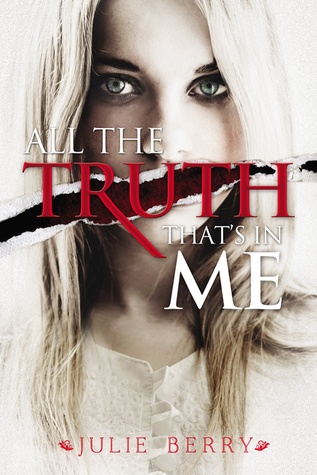
All the Truth That's In Me

Sometimes I'll take a risk on a book. I read Julie Berry's The Amaranth Enchantment many years ago and failed to be stunned by it. It lacked a certain amount of depth in both characterization and plot, if I recall correctly. 

But last week in my cute little local branch library I was wandering around the shelves, just waiting to be grabbed by something. I had a literary itch to scratch--I just needed to find the right book. I was looking for something more contemporary with a fantasy edge. The cover for All The Truth That's In Me grabbed my attention. I recognized the author, of course, and took a chance. It didn't scratch the literary itch (more on that in the next post), but I ended up loving it anyway. 


From Goodreads

"Four years ago, Judith and her best friend disappeared from their small town of Roswell Station. Two years ago, only Judith returned, permanently mutilated, reviled and ignored by those who were once her friends and family.

Unable to speak, Judith lives like a ghost in her own home, silently pouring out her thoughts to the boy who’s owned her heart as long as she can remember—even if he doesn’t know it—her childhood friend, Lucas.

But when Roswell Station is attacked, long-buried secrets come to light, and Judith is forced to choose: continue to live in silence, or recover her voice, even if it means changing her world, and the lives around her, forever.

This startlingly original novel will shock and disturb you; it will fill you with Judith’s passion and longing; and its mysteries will keep you feverishly turning the pages until the very last."


I LOVE THE VOICE IN THIS BOOK. It's written entirely from Judith's perspective, and Julie Berry uses her internal narrative brilliantly, demonstrating Judith's kindness and observational skills to weave a fascinating mystery. Having only access to Judith's thoughts and her interactions with others, the reader's view is narrow but allows us to get a sense of Judith's innocence, in spite of what she's experienced. She doesn't rage against things that are out of her control, she doesn't despair, but continues to move forward in compassion and maturity. Her generosity of character, even when her hopes are thwarted, is demonstrated when she does her best to make a good situation out of her circumstances.

The mystery is excellent--it hinges on a tightly twisted plot that turns on Judith's lack of knowledge, but that lack isn't because she's stupid or unobservant, and she puts the pieces together remarkably well. For such a tight narrative focus, the story is rich and textured. I loved it. I was completely captivated.

Gentle Reader Alert: There were no swears that I recall, and there was some frank talk of anatomy at one point, but I didn't find it to be offensive. Judith experiences some trauma, but it's handled with care.

20 February 2016

RETRO REVIEW: Being Jamie Baker

I have a strange litmus test for how much I like a literary character--when they cry, do I feel awkward or do I sympathize? There are some characters who burst into tears and I feel like a heartless robot because I. Just. Do. Not. Care. (No, I will not give you examples. Remember, I'm a *nice* person. Most of the time. Y'know. On days of the week that end in a y.) And then there are some who have been dumped on time and time again and really, when they cry, I just want to reach through the book and poke the author for being emotionally manipulative.

BUT there are characters who earn their tears, who have taken the load of tribulation in front of them, done what they can, and have to let some of their strength leak out of their eyes for a while. So, with that beginning, I'd like to introduce one of my favorite superheroes--Jamie Baker.


I really don't want to give away too much of the story, so I'll let goodreads do the hard work:

"An accident that should end in tragedy instead gives seventeen-year-old Jamie Baker a slew of uncontrollable superhuman abilities. To keep her secret safe Jamie socially exiles herself, earning the title of Rocklin High's resident ice queen. But during a supercharged encounter with star quarterback Ryan Miller she literally kisses anonymity goodbye. Now the annoyingly irresistible Ryan will stop at nothing to melt the heart of the ice queen and find out what makes her so special. Unfortunately, Ryan is not the only person on to her secret. Will Jamie learn to contain her unstable powers before being discovered by the media or turned into a government lab rat? More importantly, can she throw Ryan Miller off her trail before falling in love with him?"

Kelly Oram is one of my favorite authors because of her superb characterization ability. Jamie is more than believable--she definitely earns her tears--and her reactions to her new life, her new abilities, and to Ryan Miller are so legit. I love the Jamie under the Ice Queen--she's witty and loving and stubborn. Her moral compass is solid, just like Captain America, though she has way better fashion sense. My favorite part of the book is her growth as she learns to control her power and become a real person, integrating her superpowers and herself into one person.

On a Facebook fan page, Kelly herself suggested that Ryan Miller looks a lot like Chris Evans. (Yay Captain America! Yeah, I'm a fan.) And Ryan himself is absolutely adorable without being cheesy--that's a difficult feat to pull off, but Kelly did it. Of course, it helps that Ryan has a giant ego. And a heart of gold. He's not perfect, but he's pretty awesome.

Of course, not everything can be sunny or this book wouldn't have any depth. In this case, Jamie's superpowers make her a target for all kinds of nefarious characters--one who absolutely surprised me the first time I read the book. Despite her tempermental teenage nature, Jamie also finds help in the least likely of places. The pacing and the plot are tight, and I find it hard to put this book down every time I read it.

Being Jamie Baker is a jewel among superhero stories. Kelly Oram has taken the angst of high school and combined it with electricity and toxic fertilizer to create a tale of loneliness and despair transformed by love into the best thing in the world--confidence and a complete sense of self. Read Being Jamie Baker. You won't regret it.

08 February 2016

Post Apocalypse and the French Terror

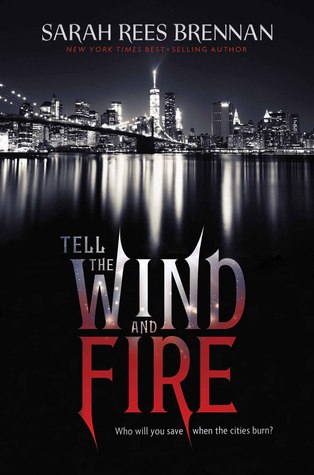
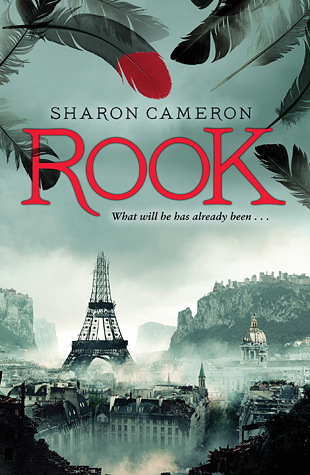
I ran into an interesting confluence of events last week. The book I requested from NetGalley, Tell the Wind and Fire, and a book I've been wanting to read for years and finally got from the library, Rook, were set in the same time period. IN THE FUTURE. Not just any future, however, but a post-apocalyptic French Terror sort of future. It was intriguing.


Sarah Rees Brennan, author of The Lynburn Legacy, has written a retelling of A Tale of Two Cities in her new book, Tell the Wind and Fire. I don't know about you, but in ninth grade English we read Dicken's A Tale of Two Cities and there was a LOT of Lucie bashing. Ms. Brennan has taken that on, making Lucie beyond redeemable. I really liked her and her courage as she stood against not only the oppressive government but the overly enthusiastic rebels as well. The story is set in a future New York City, where magic has divided the populace into two kinds of magic users--Dark and Light. The Light magicians are oppressing the Dark magicians and have walled them off from the general population, but you have the usual Romeo and Juliets out there, causing mayhem with their cross-boundary love and creating untenable situations for their offspring. Ms. Brennan's writing is beautiful, and she has a gift for giving the reader just enough information about the characters to decide if they're likable, but leaves out enough to keep them mysterious. The suspense was well done and I found the resolution satisfying.


Rook has been on my radar since it was published, but being poor makes me subject to the library's purchasing whims. *dramatic hand to forehead* But my awesome little branch library in my new city had it and I devoured it. Sharon Cameron is also the author of The Dark Unwinding series, which I loved, and Rook was yet another example of her deft writing. Her characters are gleefully complex and hate fitting in with society's expectations, something I can identify with. And the plot is richly textured too, bringing together the worlds of post-apocalyptic Britain and France like a wonderful brocade. This story is also a retelling, this time of The Scarlet Pimpernel, and was an enjoyable, tense, exciting read. I really adored it.

I'm no historian, but I think that these two stories do an excellent job of showing that man's inhumanity to man--as demonstrated by The Terror, in this case--brings out some formidable heroes and provides a complex background on which the best of men and women truly shine.